




Luxury growth teams do not win by guessing where affluent consumers might be. They win by building a precise audience once, then activating it consistently across every channel that drives awareness, consideration, and purchase.
That’s the core of Windfall’s Luxury Playbook: One Audience, Every Channel. Windfall gives you household-level wealth and affluence signals you can actually operationalize, so your Meta strategy, your CTV plan, your paid search, and your direct mail are all speaking to the same high-value households, with measurement tight enough to improve each cycle.
Affluent Attention is Shifting to Digital & Social Platforms
Reaching affluent audiences requires a digital-first strategy in which attention, influence, and affluence converge on social media platforms.
According to Altiant’s latest research on millionaire media consumption, social media now reaches 85% weekly, making it the single most pervasive channel for awareness, engagement, and influence for brands.
Online video has also overtaken television, signaling a preference for on-demand, platform-native content over linear broadcast experiences.
Across these channels, engagement isn’t passive. For affluent consumers, social and video platforms now sit at the center of discovery, consideration, and influence, with many actively liking, recommending, and following luxury brands.
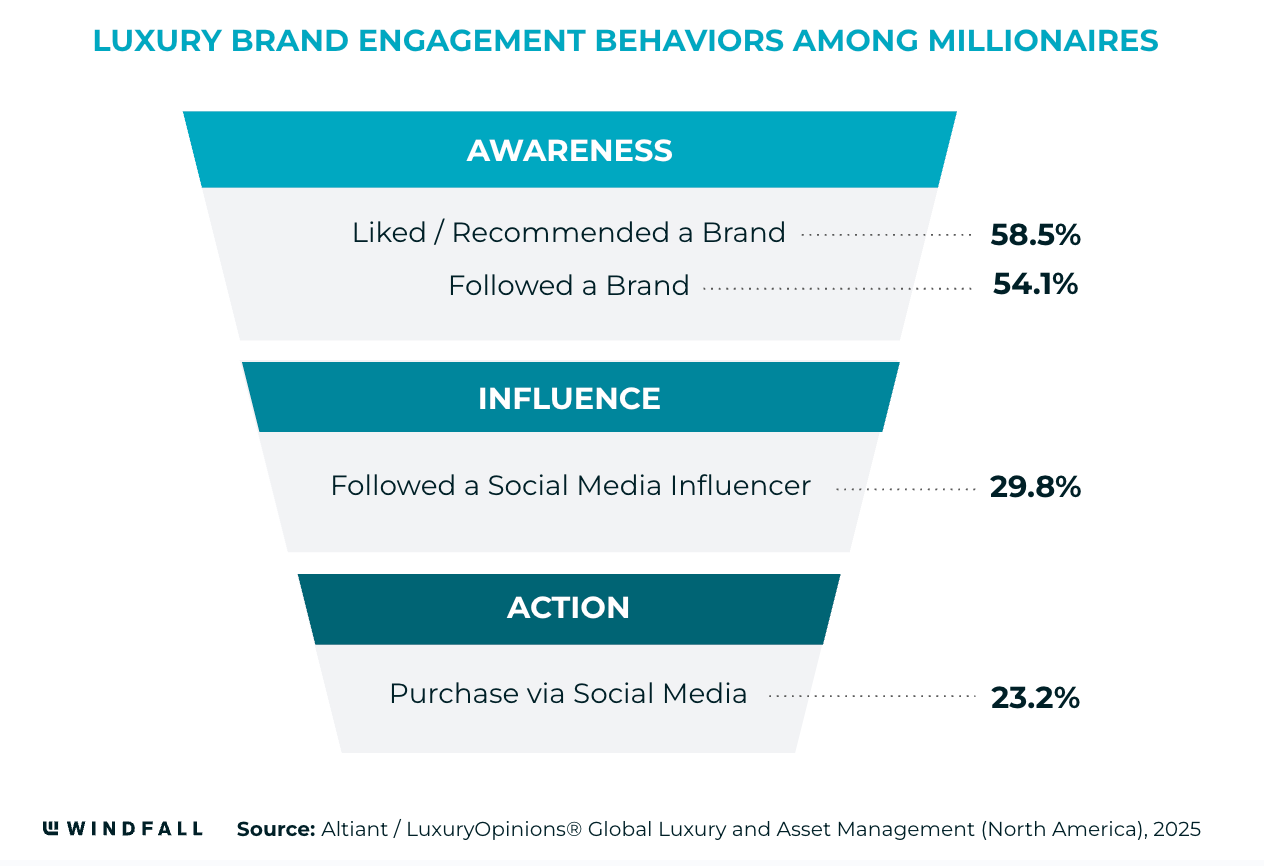
Luxury has always been multi-channel. What’s different now is the speed and frequency of digital touchpoints, which makes the “one audience” discipline more important than ever.
Why Traditional Segmentation is Challenged
A lot of luxury targeting still relies on proxies: top zip codes, broad income bands, home value, and channel-specific interest targeting. The problem is not that these are “wrong.” The problem is that they are imprecise at the household level.
In Windfall analysis using American Consumer Survey (ACS) 5-year data, even within top income zip codes, a meaningful share of households fall below common income cutoffs. In other words, a high-income zip code is not the same thing as a high-value household.
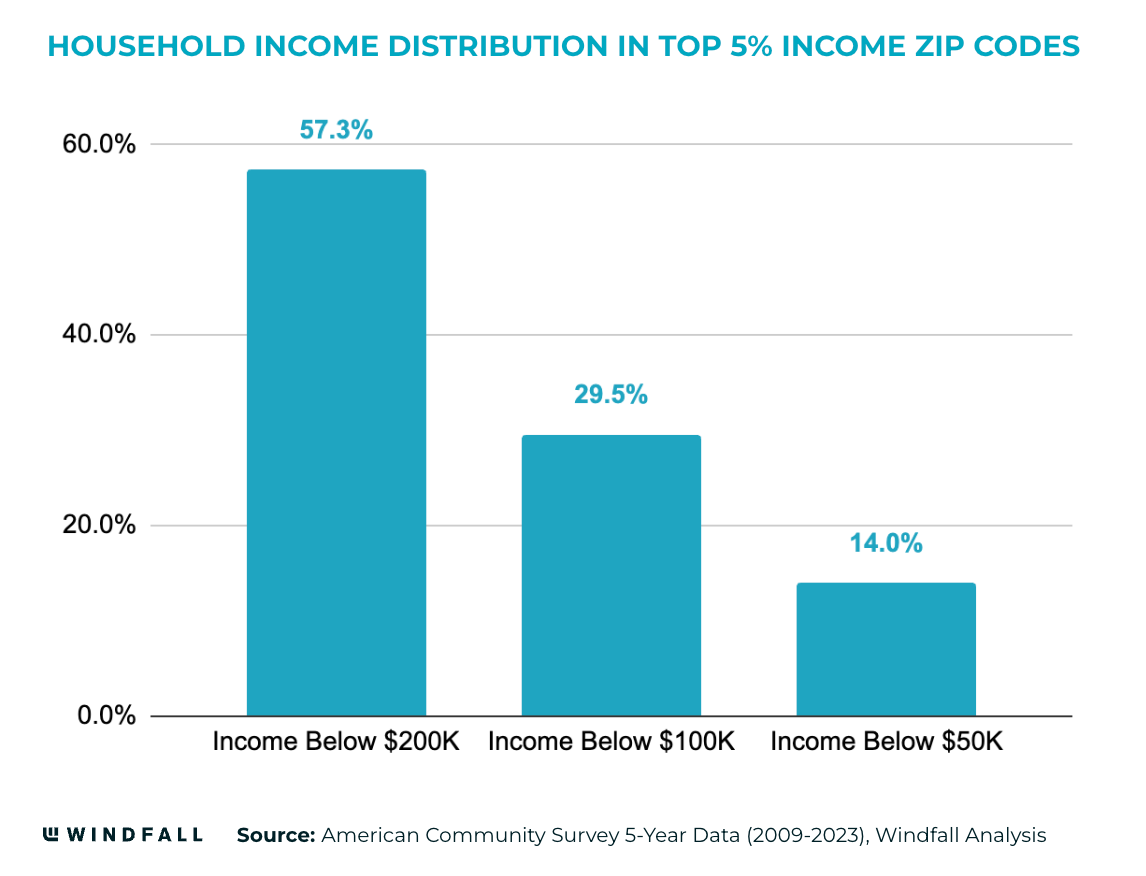
That’s how you end up with wasted touches and uneven performance. And when each channel uses a different audience definition, measurement gets messy. You’re no longer comparing like-for-like audiences, which makes it hard to answer the question that matters most: what’s working, for which households, and at what cost?
The Ideal State: Audience Orchestration with Household-Level Data
When we say orchestration, we mean something very specific: Build once → activate everywhere → measure attribution → iterate.
Here is the practical playbook:
- Define the household as your operating unit: Luxury purchase behavior is household-shaped. So is travel, real estate, and giving. If your targeting starts and ends with an email address, you are leaving money on the table.
- Build audience definitions once (and make them portable): VICs, emerging affluence, high-propensity new buyers, lapsed VIPs. Same thresholds. Same suppression logic. Same rules.
- Activate across every destination that matters: Paid social, CTV/streaming, search, programmatic, and direct mail. Your audience should not change just because the channel changes.
- Measure outcomes back to the household: Data-layer matchbacks for digital and direct mail, insights into online conversion, store visits, appointment and event attendance, clienteling outcomes, and longer-term repeat behavior. Pick the KPIs that reflect luxury reality, not just ecommerce.
- Iterate fast with clean feedback loops: Creative, offer, channel mix, frequency, and segment thresholds should improve each cycle because measurement is consistent.
Where HNW Consumers Actually Spend Time Online
Affluent attention is concentrated across a small set of platforms, with usage patterns that shift modestly quarter to quarter. The chart below highlights where HNW audiences spend meaningful time online.
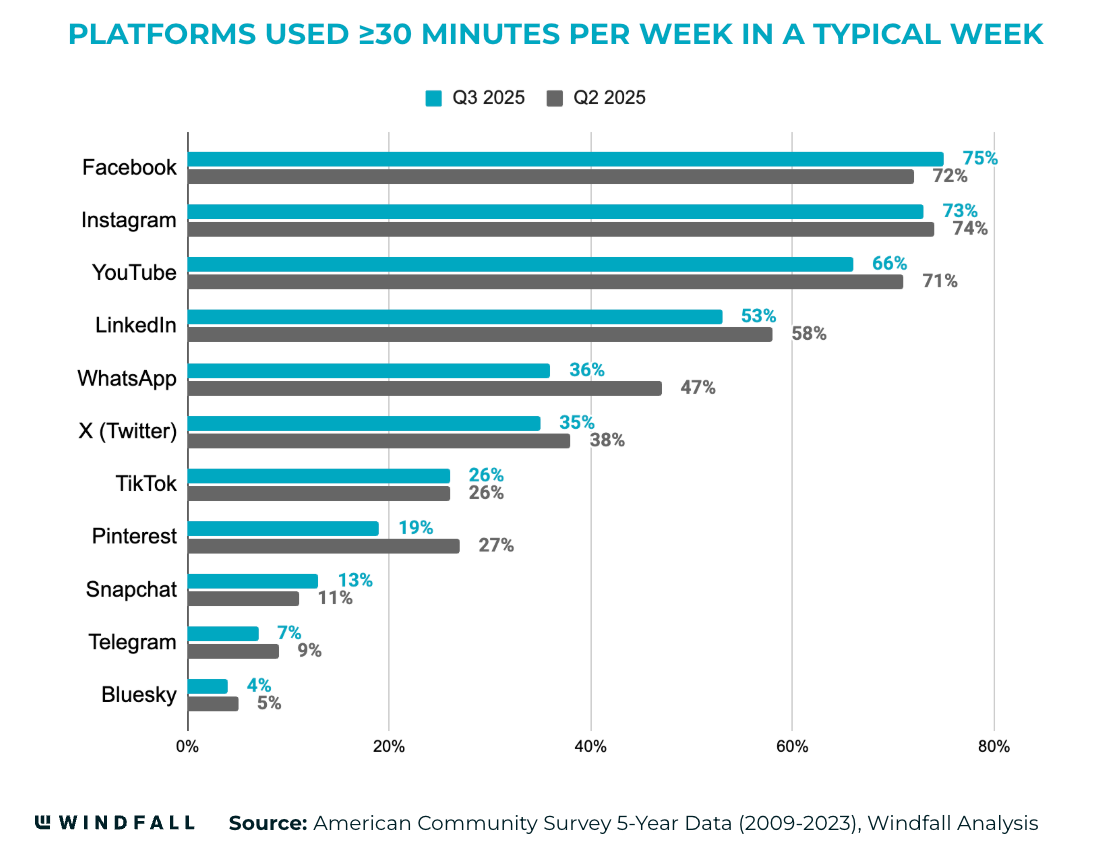
- Facebook and Instagram are still core reach platforms with the largest weekly usage
- YouTube is a primary consumption channel, and it often outperforms “linear” attention
- LinkedIn is meaningful for affluent discovery, especially for business owners and execs
- X, TikTok, and Pinterest show up as secondary channels, skewed by age and interest
One important nuance: younger millionaires are materially more likely to purchase directly from social, while 40+ cohorts over-index on Facebook, YouTube, and LinkedIn. The implication is not “pick one.” It’s about refining your strategy and creative by segment rather than by channel.
Luxury’s Unfair Advantage: Direct Mail + Digital Overlay
Luxury is one of the few categories where direct mail can still feel premium: lookbooks, private appointments, store openings, trunk shows, and high-touch invitations. The missed opportunity is when mail runs in isolation.
With Windfall, the overlay becomes straightforward:
- Build a precise household audience using wealth and affluence signals
- Mail only the households that match the segment definition
- Retarget those same households across paid social and streaming to reinforce the story
- Measure outcomes with matchbacks and consistent attribution windows
- Use results to refine the segment and scale what works
What Windfall Changes for Luxury Teams
Windfall is the precision layer that makes “one audience, every channel” operational. You can define household-level segments using wealth and affluence signals, activate them across marketing destinations, and keep measurement consistent enough to iterate quickly.
If you want a simple starting point: pick one high-value use case (new VIC acquisition, lapsed VIP reactivation, store event attendance), run a coordinated direct mail + digital overlay, and commit to a clean measurement plan before you launch. Then iterate from evidence, not intuition.
Ready to make your audience portable across every channel? Schedule a Windfall demo to see how household-level wealth signals power precise targeting across digital and direct mail, with measurement you can actually act on.