



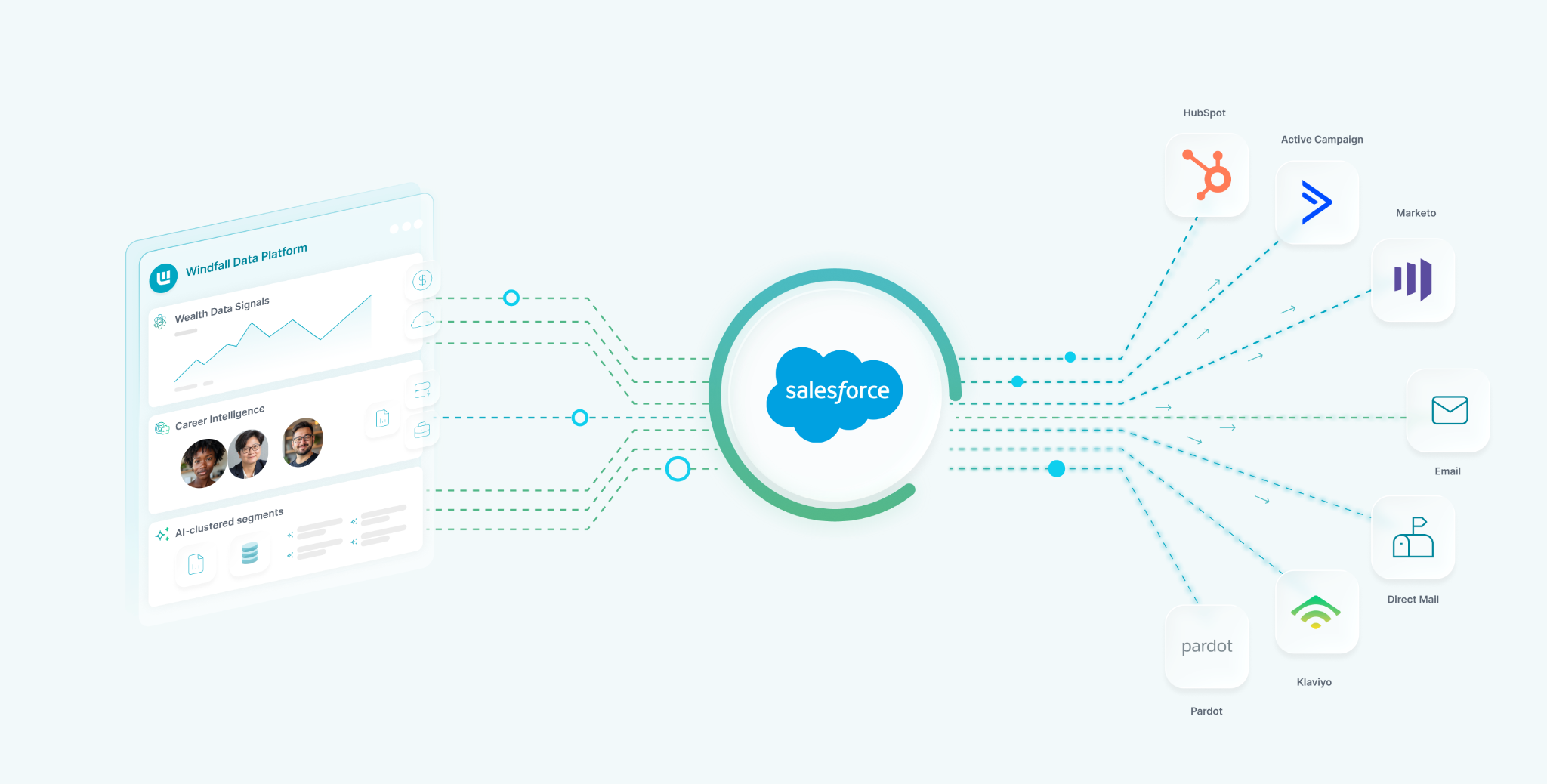

Salesforce sits at the center of go-to-market operations. It holds contacts, leads, opportunities, and now, increasingly, the intelligence layer that determines who gets reached, when, and how. Activating people intelligence from a third-party platform into a live Salesforce Campaign has historically meant manual export and re-upload cycles.
Windfall has removed that friction with ability to deploy Salesforce Campaigns directly from the Windfall Application. Now experience a bi-directional, closed-loop integration between Windfall's people intelligence and your entire go-to-market stack. For commercial teams in wealth management, luxury, financial services, and sports, and nonprofit organizations running major gift and annual fund campaigns, this means the data you've been using to build world-class Segments in Windfall can now flow directly into the campaigns driving your revenue and fundraising outcomes.
1. Salesforce Is Not Going Anywhere—And That's the Point
It has become fashionable in some corners of the marketing world to speculate about the future of CRMs. But the data tells a different story: Salesforce adoption continues to grow, and for most enterprise go-to-market teams, it remains the irreplaceable center of gravity for pipeline, account management, and campaign execution.
The challenge has never been Salesforce itself. The challenge has been getting the right data into Salesforce at the right time, and then making sure that data travels from Salesforce to the downstream tools where campaigns actually run.
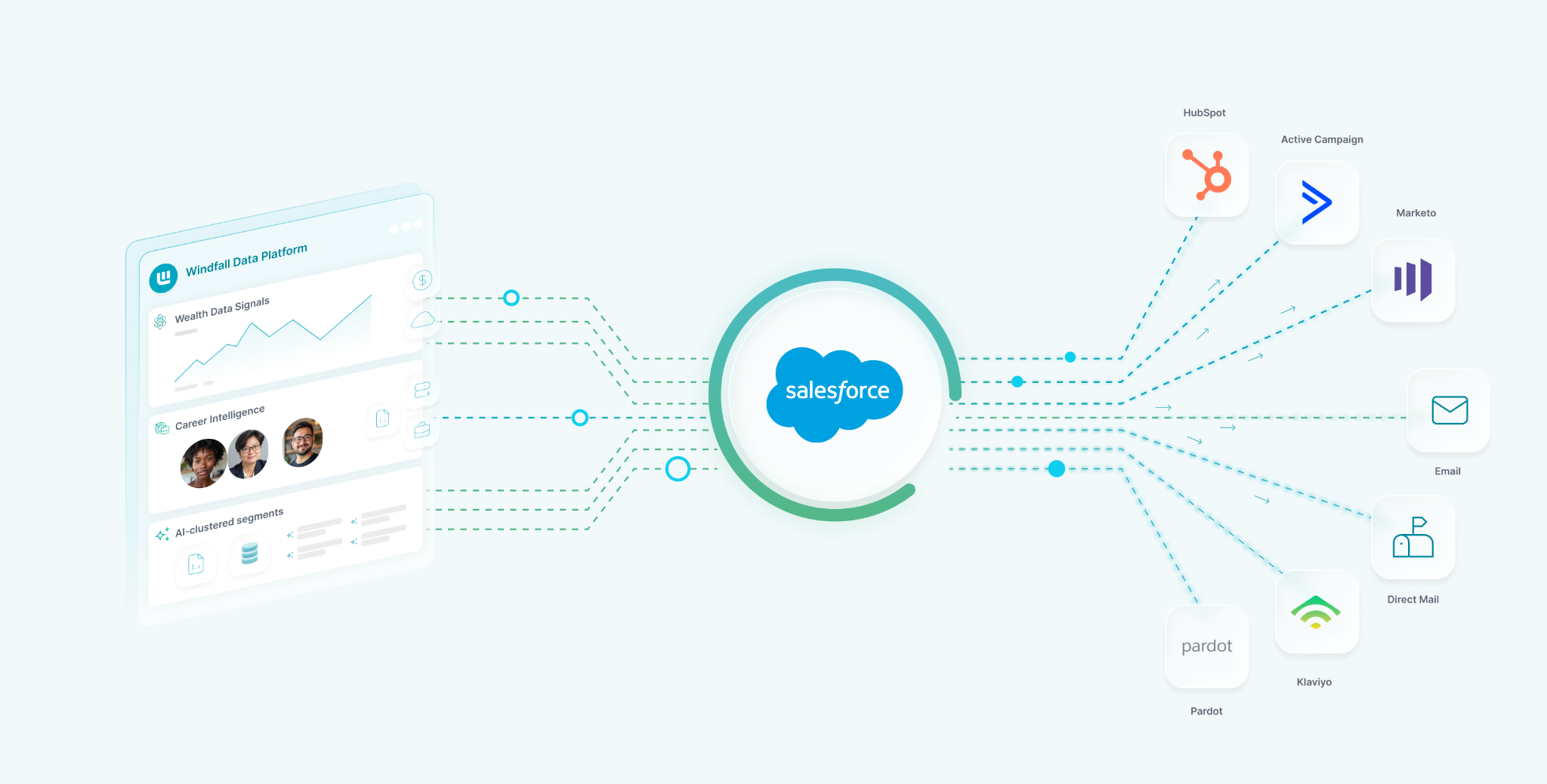
This is where the Salesforce Campaign Object becomes critical. It is not just another record type. It is Salesforce's native hub for the entire martech ecosystem. It connects natively to Marketo, Klaviyo, HubSpot, Pardot, ActiveCampaign, ExactTarget, and more. When data is written to a Campaign Record, it does not stay isolated in Salesforce. It flows downstream to every connected platform, automatically, without requiring separate integrations or manual synchronization.
→ See all of Windfall's partners and integrations.
Writing data to Contacts and Leads is powerful, but one step removed from this hub. With the new Campaign Object integration, Windfall writes directly to the hub itself, and the rest of your martech stack follows.
And because Salesforce now natively integrates with Slack, a Campaign Record created from a Windfall Segment can also anchor a Slack channel. This gives RevOps and marketing teams a live collaboration thread tied directly to the campaign they are running. The hub model means that one activation in Windfall ripples outward across an entire connected organization.
2. Closing Workflow Gaps
Previously, teams would build a Segment in Windfall, export it as a file, navigate to Salesforce, create or locate the right campaign, upload the list, map the fields, and then verify that everything landed correctly.
Manual workflows have inherent complexities including:
- Latency: Days could pass between when a Segment was built and when it was live in a campaign.
- Data drift: People who became ineligible between export and upload remained in the campaign. People who became newly eligible were missed.
- Human error: Field mapping mistakes, duplicate records, and upload failures created list hygiene problems that took additional cycles to clean up.
- No history: Teams had no centralized record of which Windfall Segments had been activated, when, or to which destinations.
Windfall has now closed this gap with its Salesforce Campaign Object integration.
3. The Data Standard CRM Enrichment Can't Reach
Most CRM enrichment tools cover the basics: job title, company, estimated income, and generic demographic attributes. These are useful, but they are available everywhere. They do not differentiate.
Windfall's segmentation attributes are differentiated. A meaningful portion of these unique attributes do not exist anywhere else. When combined with the Campaign Object integration, these attributes unlock targeting and segmentation that no other vendor can replicate.
Consider what is now directly deployable into a Salesforce Campaign:
- Seasonal residency data. Identify snowbird households who split time between primary and secondary residences, enabling hyper-targeted campaigns timed to their location patterns.
- Liquidity signals. Identify households with recent liquidity events such as stock vesting, business sales, or inheritance indicators.
- Investable asset ranges. Segment beyond income into actual deployable wealth.
- Waterfront and dock property owners. Ideal for marine, luxury travel, and private wealth brands.
- Golf community residents. High-affinity audiences for hospitality, wealth management, and luxury goods.
- Ski resort adjacent properties. Seasonal lifestyle targeting for premium brands.
- Equestrian lifestyle data. A distinct, high-net-worth audience Segment that generic enrichment tools miss entirely.
These attributes come from Windfall's proprietary dataset covering over 100 million US households, built from deterministic signals rather than estimates or self-reported inputs.
→ Explore Windfall's solutions for retail, travel and hospitality, financial services, and nonprofit fundraising teams to see how Windfall Segments power real campaigns.
When your Salesforce Campaign is populated with a Windfall Segment built on these attributes, you are not running the same campaign as everyone else. You are running the only campaign that could have been built this way.
4. How to Deploy a Salesforce Campaign Directly from Windfall
The new workflow is straightforward and requires no technical resources to execute. Here is the step-by-step process.
Step 1: Navigate to Your Segment in Windfall
Open the Windfall Application and navigate to the Segment you want to activate. This can be any Segment, whether you built it using wealth ranges, career intelligence, lifestyle attributes, propensity scores, or a combination.
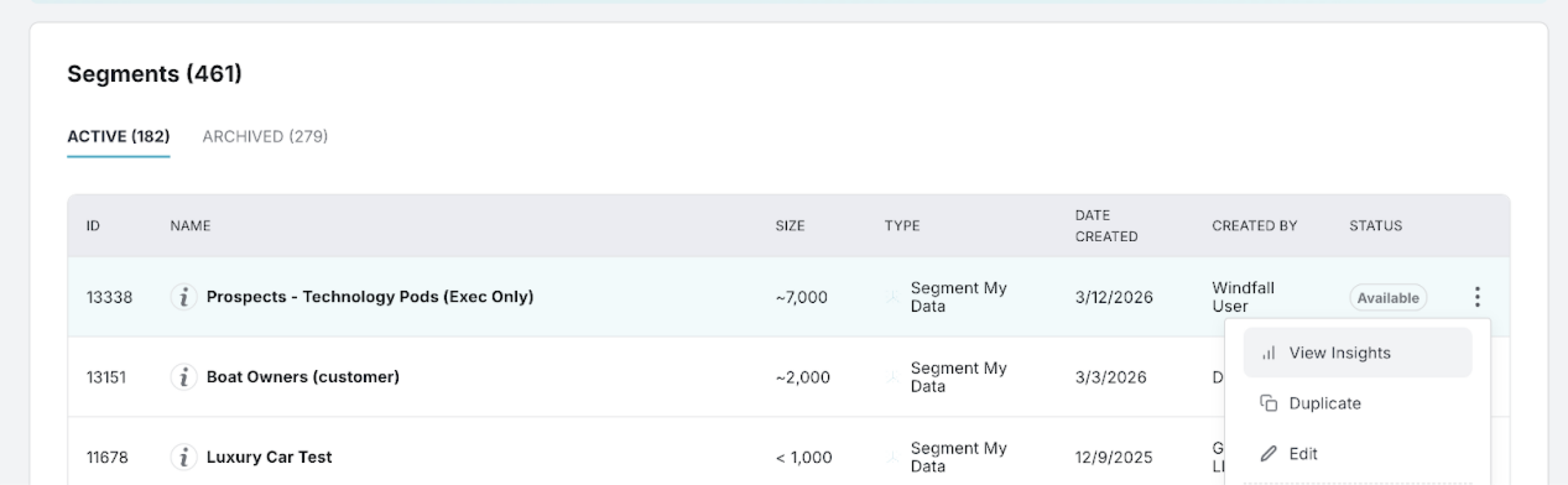
Step 2: Open Insights and Go to Actions
Click "View Insights" on your Segment to open the Segment detail view. From there, navigate to the Actions menu.
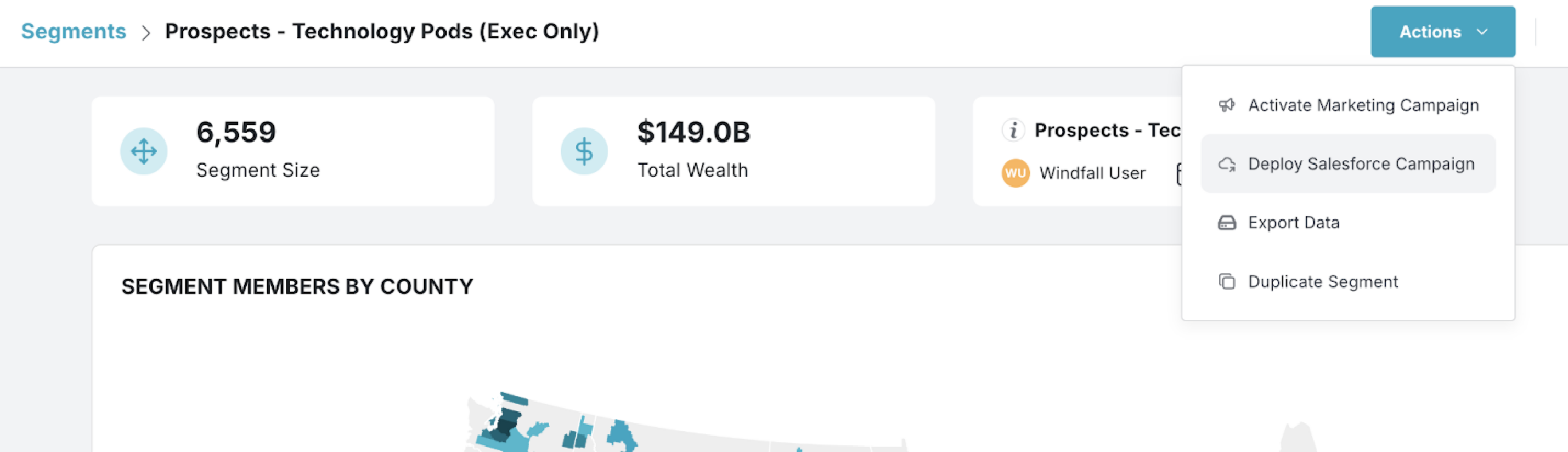
Step 3: Select "Deploy Salesforce Campaign"
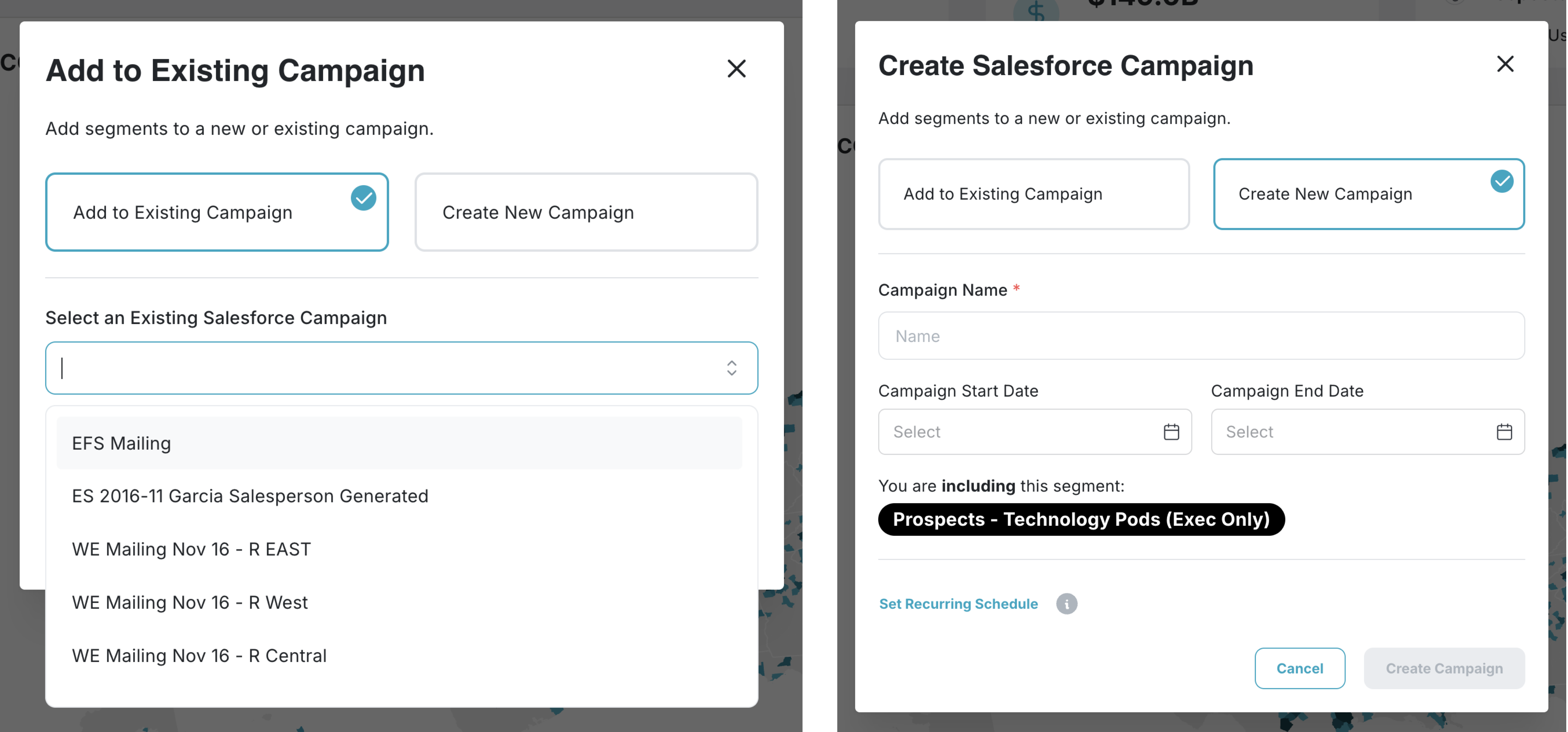
From the Actions menu, select "Deploy Salesforce Campaign." Windfall will connect to your Salesforce instance and present you with two options:
- Add to an Existing Campaign. Search for and select a Salesforce Campaign you have already created.
- Create a New Campaign. Enter a campaign name, start date, and end date directly from within Windfall.
Step 4: Set Your Refresh Cadence (Optional but Recommended)
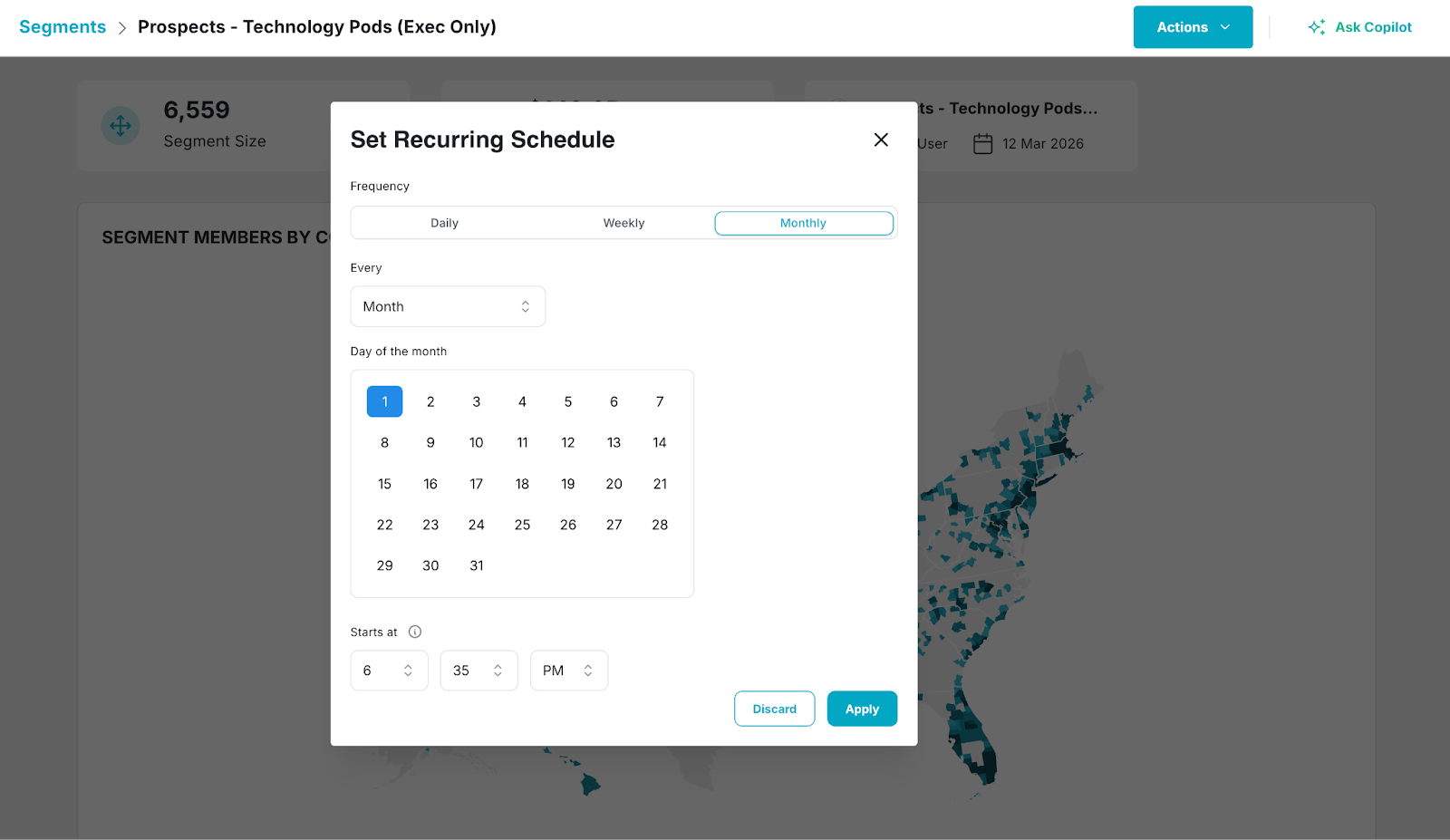
For ongoing campaigns, enable a recurring schedule, daily, weekly, or monthly. Windfall will automatically re-evaluate the Segment against your criteria on the selected cadence and update the campaign membership accordingly.
This means your campaign audience stays fresh. People who no longer meet your criteria are handled cleanly, and newly qualifying members are added without manual intervention.
Step 5: Confirm and Deliver
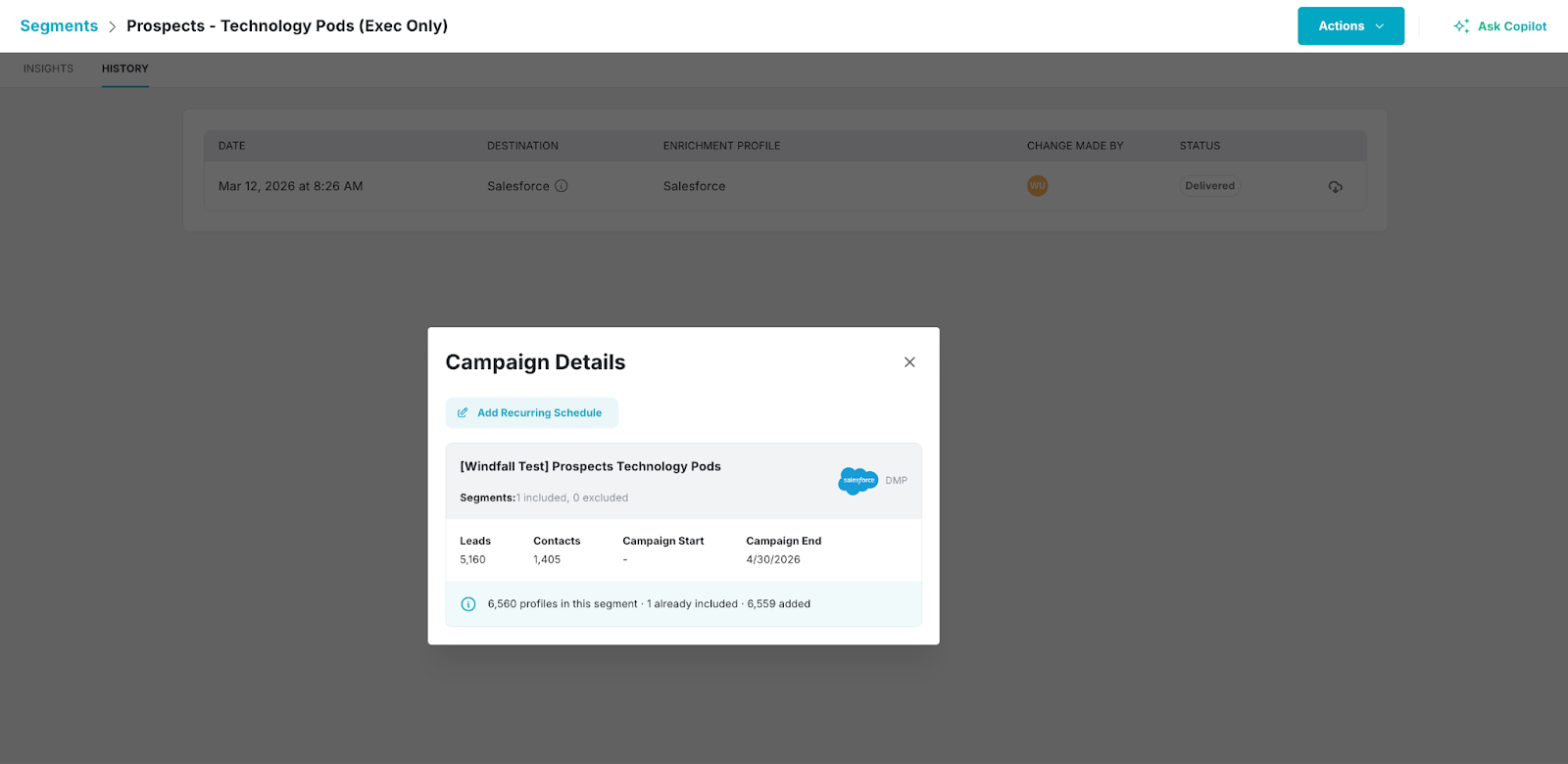
Review your configuration and click to deploy. Windfall checks for existing campaign members before adding anyone new. No duplicate members are created. Any overlap is tracked as "Already Included" so your campaign statistics remain clean.
Once the deployment is complete, the activation appears in Windfall's History tab with "Salesforce" listed as the destination and a "Delivered" status. You have a centralized audit trail of every Salesforce Campaign activation, every time.
5. Closing the Loop: How Windfall Pulls Performance Data Back
Deploying a Windfall Segment to a Salesforce Campaign is the activation step. But the real value of the Campaign Object integration is what happens after activation. The bi-directional sync that turns campaign data into proof of ROI.
Once your Windfall Segment is live in a Salesforce Campaign, Salesforce begins populating the Campaign Statistics panel with performance data tied directly to that audience:
|
METRIC |
WHAT IT SHOWS |
|
Responses in Campaign |
Members who responded to any campaign activity |
|
Leads in Campaign |
Total leads associated with this campaign |
|
Contacts in Campaign |
Total contacts associated with this campaign |
|
Converted Leads |
Leads that converted to opportunities |
|
Opportunities in Campaign |
Active opportunities influenced by this campaign |
|
Won Opportunities |
Closed-won deals traced to campaign members |
|
Value of Won Opportunities |
Total revenue attributed to this campaign audience |
This data flows back into Windfall's reporting layer, where campaign performance dashboards show you Campaign Members, Meetings Booked, Qualified Opportunities, and Pipeline Touched. These are all tied to the original Windfall Segment that powered the audience.
The parent/child campaign hierarchy in Salesforce takes this further. Teams can create a parent campaign, for example, a broad acquisition initiative with nest individual segment-driven campaigns beneath it as children. This enables a portfolio view of Windfall's total impact across multiple programs, audiences, and time periods.
For revenue teams, this is the answer to the question that every CFO and CMO eventually asks: What is the ROI of our data investment?
With Windfall's Campaign Object integration, the answer is no longer a process. It is a dashboard.
6. A Note on Adoption: The Data Pays Off When Teams Use It
One of the most important things to understand about the Salesforce Campaign Object integration is that its value compounds with usage. Each time a team builds a Segment, deploys it to a Salesforce Campaign, and reviews the results, they close a loop. They learn which audiences convert. They refine their next Segment. They build institutional knowledge about what works.
This is not a feature to set up once. It is a rhythm to establish. Teams that make Windfall Segment deployment a standard part of their campaign planning process—rather than a one-time experiment—are the ones that build the renewal and expansion story that justifies the data investment over time.
The integration also supports recurring schedules precisely because audiences change. People get promoted, move, inherit wealth, and retire. A campaign audience that was accurate on day one may drift meaningfully by day 30. Windfall's recurring refresh ensures the Segment stays current, so your campaign always reflects who those people are today, not who they were at the time of the last export.
7. Who This Is Built For
The Salesforce Campaign Object integration is available to all Windfall customers with an active Salesforce integration.
For commercial teams, this means activating Windfall's wealth, lifestyle, and career intelligence directly into the campaigns driving acquisition, upsell, and retention. Whether you are a luxury brand targeting high-net-worth households, a financial services firm identifying liquidity events, or a sports and entertainment property building premium audience campaigns, the path from Windfall Segment to live Salesforce Campaign is now a five-step workflow.
For nonprofit organizations, this means connecting donor wealth intelligence and propensity scores to specific fundraising campaigns, and then measuring the dollar impact of those campaigns directly in Salesforce. Development teams can now see exactly which Windfall-powered audiences drove the most engagement, the most converted donors, and the most revenue per campaign member. Setup is straightforward and your Windfall customer success team can walk through the configuration in a single call.
Getting Started
Windfall has built one of the most sophisticated people intelligence platforms available to go-to-market teams. The Salesforce Campaign Object integration streamlines activation of that intelligence.
You can now build a Segment from attributes that no other platform provides, deploy it to a Salesforce Campaign in minutes, schedule it to stay fresh automatically, and measure the revenue impact, all without leaving Windfall or running a single manual export.
This is what closed-loop data activation looks like in practice. If you are an existing Windfall customer with a Windfall Salesforce Integration, reach out to your customer success manager to enable the Campaign Object deployment feature today.
If you are new to Windfall, request a demo to see how people intelligence, Predictive AI, and seamless CRM activation can transform the way your team identifies and engages its best customers. You can also explore our full integrations and partners ecosystem to see how Windfall connects with your existing stack.