



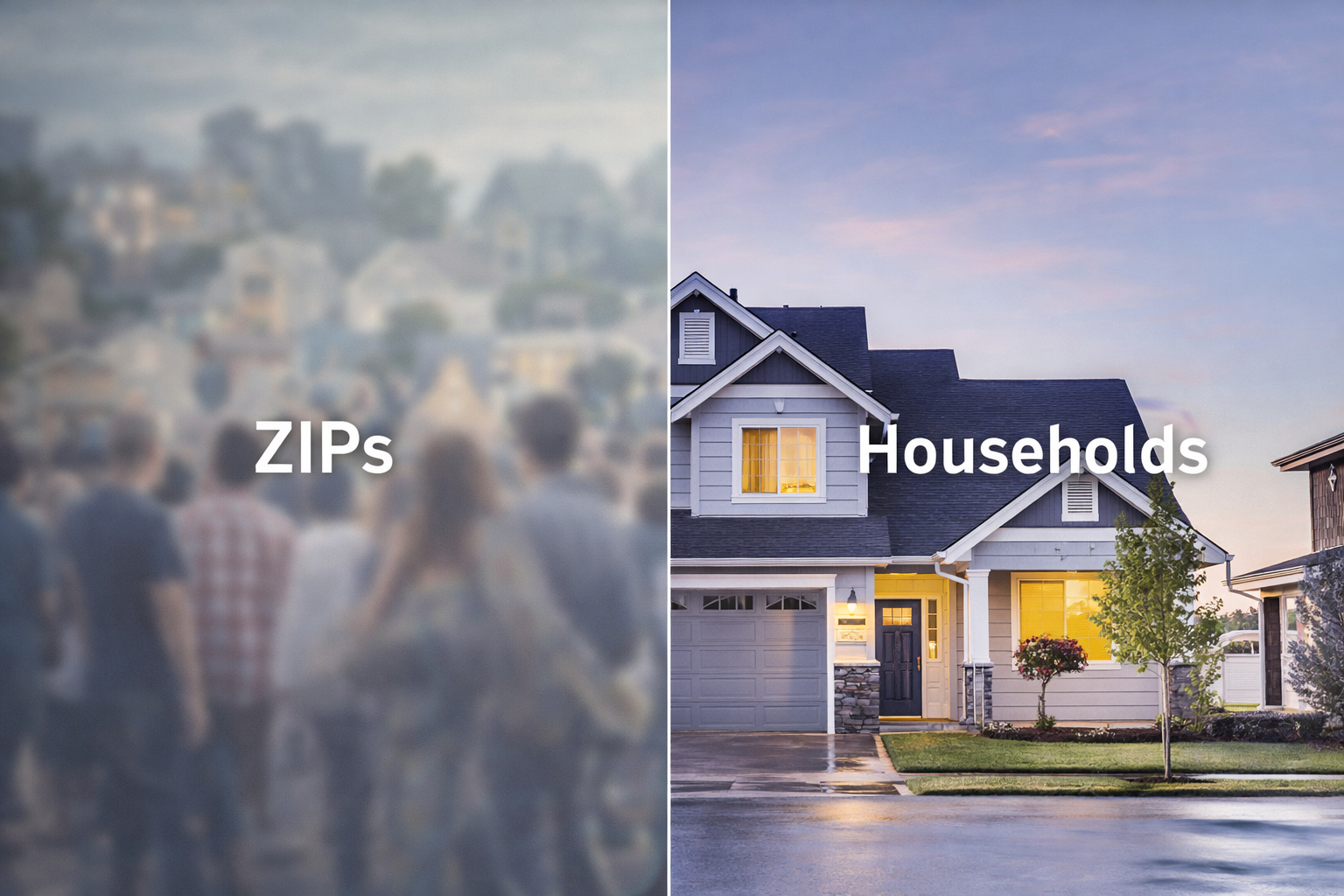

For years, “top ZIP” targeting has been the go-to tactic for finding affluent consumers and donors. Top 5% ZIP codes. High-income ZIP codes. Affluent neighborhoods. On a slide, it sounds sophisticated. In practice, it’s an expensive illusion.
If you care about high-net-worth prospects, capable donors, or premium buyers, ZIP-based targeting is suboptimal because it:
- Wastes budget on the wrong households, and
- Skips a surprising number of the households that actually matter
ZIP-code-level income estimates operate on averages. You’re buying a story about affluence, not households that are actually affluent.
This post lays out:
- Why ZIP and income proxies are structurally flawed
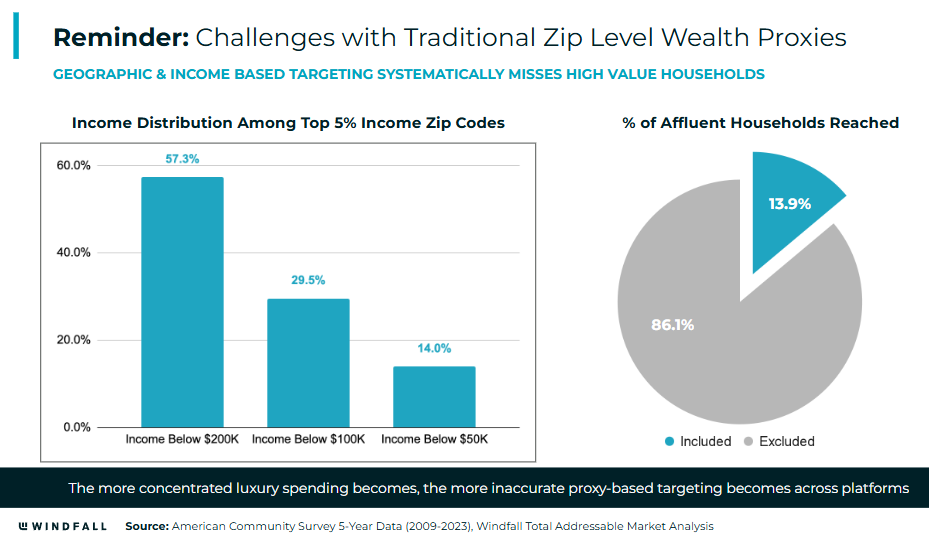
- The “top 5% ZIP codes” problem (and why you’re reaching far fewer affluent households than you think)
- What changes when you switch to deterministic, household-level wealth data
The ZIP Code Targeting Illusion
The ZIP Code system (an acronym for Zone Improvement Plan) is the postal code system used by the United States Postal Service (USPS). ZIP-level and census income segments became popular because they’re:
- Easy to activate on nearly every media platform
- Easy to explain to non-technical stakeholders
- Easy to justify: “We’re targeting wealthy neighborhoods”
This feels like precision, but it’s not. A ZIP Code is:
- A postal boundary, not an economic segment
- A mix of incomes, ages, life stages, and households
- A rough proxy that smooths all that complexity into a single number
ZIP Code Targeting rests on a single flawed assumption: “If the average is high, the households here are probably high-income enough for our campaign.” That leap—from the average of an area to the attributes of a household—is where the math breaks.
The “Top 5% ZIP Codes” Problem
The most common version of ZIP-based affluence targeting sounds like this: “We restricted our campaign to the top 5% (or top decile) of ZIP codes by income to reach affluent households.” It sounds tight and focused. But here’s what’s really happening:
- “Wealthy ZIPs” Contain a Lot of Mass-Market Households
- Most Affluent Households Don’t Live in Those Specific ZIPs
- “Top 5% of ZIP Codes” ≠ “Top 5% of Households”
1. “Wealthy ZIPs” Contain a Lot of Mass-Market Households
Just because someone lives in a top 5% ZIP code does not mean they are the affluent core your strategy is built around. Even in the “best” ZIP codes, you’ll find:
- Renters and roommates
- Lower-income households squeezed by the local cost of living
- Early-career professionals who haven’t reached their earning potential
- Retirees on modest, fixed incomes
When you target the “top 5% ZIPs,” you’re paying premium CPMs to reach people whose only qualifying trait is their mailing address. Some will be truly affluent households, but a large volume will be made up of non-affluent households sitting next door. According to our estimates, when targeting the "Top 5%" Income Zip Codes, 57.3% of households have a household income below $200K, 29.5% of households have a household income below $100K.
2. Most Affluent Households Don’t Live in Those ZIPs
High-income and high-wealth households are:
- Spread across “average” suburbs and exurbs
- Scattered in small towns and rural areas
- Embedded in gentrifying or mixed-income neighborhoods
- Increasingly geographically diffuse due to remote work and new wealth patterns
When you lock yourself into “top 5%” or “top decile” ZIP codes, you are choosing to ignore:
- Affluent families who prefer “normal” neighborhoods
- Business owners and professionals living outside legacy “wealthy ZIPs”
- High-capacity households whose address wouldn’t make a “luxury ZIP” list
So your media plan can say “we target affluent households,” but structurally, you can only reach affluent households within the chosen ZIPs, and you reach zero affluent households outside that boundary.
3. “Top 5% of ZIP Codes” ≠ “Top 5% of Households”
This is the crux of the problem. When you buy the “top 5% of ZIP codes by income,” you are not buying the top 5% of households by income or wealth.
Two things happen simultaneously:
- Only a fraction of truly affluent households actually live inside those ZIPs.
- Within those ZIPs, a large share of households are not affluent at all—they’re just living in high-cost areas.
The net effect:
- Your real coverage of truly affluent households is far below 5%.
- Your spend on non-affluent households is far higher than your reports suggest.
- You’re blind to a huge number of affluent households in excluded ZIPs that never even see your message.
ZIP-based reporting hides this gap by labeling everything inside those boundaries as “affluent geography,” even when many of the households you’re paying to reach don’t resemble your target at all.
Why Zip Code Targeting Hurts More Now Than It Used To
ZIP proxies were always crude, but three trends make them even riskier today:
- Affluence is geographically fragmented. Wealth is no longer locked into a few coastal or legacy-wealth neighborhoods. Remote work, new industries, and housing dynamics have spread high-income households widely.
- Media is more expensive. As CPMs rise, every wasted impression costs more. Blunt proxies that might have been “good enough” when media was cheap are now margin killers.
- Expectations for performance are much higher. Boards, CFOs, and advancement committees expect campaigns to tie back to pipeline, revenue, or gifts—not impressions in “nice ZIP codes.”
ZIP-based targeting is at odds with modern performance requirements.
From Proxies to Proof: Deterministic Household-Level Data
The alternative is straightforward. Instead of guessing who’s affluent based on where they live, use deterministic, household-level wealth data to build your target audience.
“Deterministic” here means:
- You’re working with record-level data about specific households
- Attributes are directly tied to a household, not inferred from an area average
- Inclusion/exclusion is based on defined economic criteria, not a geographic guess
Depending on the provider and use case, household-level data can include:
- Net worth and assets estimates
- Homeownership and property value
- Indicators of giving capacity or wealth
- Life-stage and composition flags (families, retirees, etc.)
This lets you segment like this: “Target households in the top X% by income or wealth in our market, regardless of ZIP.”
What Household-Level Wealth Data Actually Changes
1. You Actually Reach More of the Households You Want
When you build your audience from household records instead of ZIPs, you can:
- Capture affluent households sprinkled across “average” ZIPs
- Reach high-value donors or buyers in places your current filters ignore
- Expand coverage of your true high-capacity audience without blindly expanding geography
Your effective reach into the audience you care about goes up—even if your media budget doesn’t.
2. You Dramatically Cut Waste in “Wealthy” Areas
Because you’re targeting households, not ZIPs:
- Non-affluent renters in high-cost neighborhoods don’t make the list
- Households that fall below your income/wealth thresholds can be excluded, even inside famous “wealthy ZIPs”
- You buy fewer impressions to people who are unlikely to qualify as major customers or donors, no matter how good your creative is
You’re no longer paying a ZIP’s premium just to talk to everyone who happens to live inside it.
3. Your Segments Finally Reflect Economic Reality
Household-level wealth data allows you to express your strategy in business terms, not geographic stand-ins:
- “Top 10% by estimated income in our footprint”
- “Net worth above $X, with property value above $Y”
- “High-capacity donors with past giving plus asset indicators”
From there you can:
- Create different segments for “emerging affluent” vs “established wealth” vs “ultra-high capacity”
- Calibrate asks, offers, or product positioning realistically
- Align marketing, sales, and development around a shared, measurable definition of “affluent”
ZIP codes can’t do that. They can only approximate.
4. You Get Cleaner Performance Signal and Learning
When your “affluent” audience is a ZIP bucket, performance analysis is always distorted:
- Poor results might be a creative problem—or just evidence that half the ZIP was never a fit.
- Great results might be powered by a thin band of truly affluent households — hidden inside a mass of non-prospects.
With deterministic household-level segments, you can:
- See performance by actual income/wealth tier
- Understand which segments drive premium AOV, large gifts, or higher LTV
- Continually refine who you consider “high value” based on real outcomes
It becomes a closed-loop system: well-defined economic segments → targeted delivery → measured outcomes → smarter future segments.
Side by Side: ZIP Proxies vs Household-Level Wealth
|
DIMENSION |
ZIP / INCOME PROXIES |
HOUSEHOLD-LEVEL WEALTH DATA |
|
Targeting unit |
Area (ZIP, census geography) |
Household (record-level) |
|
Affluence basis |
Area average |
Household attributes (net worth, assets, property, debt, etc.) |
|
Coverage of affluent HHs |
Partial; zip-limited |
Broad; wherever affluent households actually reside |
|
Waste on non-affluent HHs |
High; non-affluent in “wealthy” ZIPs |
Low; explicit inclusion/exclusion by criteria |
|
Segment flexibility |
Low (wealthy vs non-wealthy ZIP) |
High (tiers, segments, combinations of attributes) |
|
Measurement clarity |
Muddy; area bias and mixed populations |
Clear; performance by attribute-based segments |
|
Alignment with business goals |
Indirect (“expensive ZIPs”) |
Direct (“top X% income/wealth; capacity above Y, located in Z market”) |
What This Means for Your Marketing Budget
If you’re currently leaning on ZIP-based affluence, three things are probably true:
- Your true affluent reach is lower than what you planned. “Top 5% ZIPs” sounds like the top 5% of households; in reality, you’re hitting a much smaller fraction of the true affluent universe.
- A meaningful chunk of spend is going to low-probability households. They live in fancy ZIPs. They’re not actually in the wealth band your campaign needs.
- You’re blind to affluent opportunity in “normal” ZIPs. Those households are structurally excluded from seeing your message at all.
When you move to deterministic household-level wealth data, the budget that previously paid for the ZIP “halo effect” starts flowing toward actual high-capacity households. CPAs on truly valuable outcomes improve (qualified leads, premium purchases, major gifts). Marketing investment becomes much easier to defend when targeting inputs align directly with your business's definition of value.
How to Start Moving Beyond ZIP Targeting
You don’t have to flip the switch overnight. A practical migration path looks like this:
- Audit where ZIP is hiding in your strategy.
- Where do you use “affluent ZIPs,” “high-income geos,” or “top decile areas”?
- How are those choices justified internally?
- Define “affluent” in business, not geography, terms.
- Income thresholds? Net worth? Giving capacity?
- Create clear tiers (e.g., Core Affluent, High Net Worth, Ultra) aligned to your offerings or ask amounts.
- Stand up household-level segments alongside existing ZIP tactics.
- Build deterministic audiences that match your economic tiers.
- Run controlled tests: household-level vs ZIP-based, with the same creative.
- Measure on meaningful outcomes, not proxies.
- Cost per qualified opportunity, premium purchase, donor above $X, etc.
- Look specifically at incremental reach toward high-value outcomes from households outside your “top ZIP” universe.
- Shift budget with proof.
- As household-level segments outperform, move spend away from ZIP proxies.
- Over time, reserve ZIP for what it’s good at (coverage, not affluence) and let household data own your wealth strategy.
The Bottom Line
ZIP code targeting isn’t just a little imprecise; it’s misaligned with how wealth is actually distributed today. Relying on “top 5% ZIP codes” to reach affluent households:
- Overstates your reach into truly affluent audiences
- Overpays for non-affluent households who share a ZIP, not a profile
- Overlooks a huge share of high-income, high-capacity households living outside legacy “wealthy ZIPs”
With household-level wealth data, you stop targeting ZIP codes and start targeting people in households that meet your criteria. Your definitions of “affluent,” “major donor,” or “premium buyer” become explicit and measurable. Your media dollars align with the economic reality of your market—not the convenient fiction of a few famous ZIP codes.
ZIP code targeting had a good run. But if you’re serious about maximizing budget against the top affluent households, it’s time to recognize ZIP code targeting as legacy scaffolding that should be replaced by deterministic, household-level wealth data.
If you’re ready to see how household-level wealth intelligence can transform your go-to-market strategy, request a demo today.