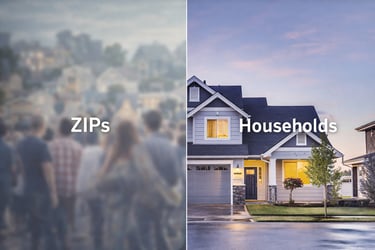




Luxury marketing has long been obsessed with targeting: income bands, ZIP codes, past purchases, loyalty tiers. But in today’s market, targeting alone is table stakes.
The difference between a brand that gets ignored and a brand that gets invited in often comes down to reaching the right client at the right life moment:
- New movers.
- Liquidity events.
- Career changes
- Retirements
- Marriage
- Divorce
These are not just data points—they are windows of intent.
Why Triggers Outperform Static Targeting
Traditional segmentation answers the question: “Who can afford this?”
Trigger-based marketing answers the better question: “Who is most likely to act right now?”
A high-net-worth household that hasn’t changed in five years may be valuable. But a high-net-worth household that:
- Just sold a company
- Just moved into a $4M home
- Just accepted a C-suite role
- Just announced retirement
…is exponentially more likely to engage with premium experiences, bespoke services, or major purchases.
Triggers introduce urgency and relevance.
High-Impact Luxury Triggers
Below are three of the most powerful trigger categories for luxury brands:
- Recent Movers
- Liquidity Events
- Career Changes & Retirement
1. Recent Movers
A move is one of the highest-spend life events. Especially in the luxury segment.
New movers often signal:
- Home furnishing and décor spend
- Renovation and design services
- Security systems and smart home upgrades
- Fine art acquisition
- Automotive upgrades
- Local luxury retail exploration
2. Liquidity Events (Business Sale, IPO, Major Asset Sale)
Liquidity changes everything. A founder who exits a company or an executive who vests shares may move from high earning to high wealth overnight.
These events signal:
- Upgraded travel preferences
- Private aviation exploration
- Ultra-luxury real estate purchases
- Bespoke financial services
- Philanthropic planning
- Fine jewelry and watch acquisition
3. Career Changes & Retirement
A new role often brings new income, new geography, and new networks.
Signals to watch:
- Promotion to C-suite
- Board appointments
- Transition to private equity or venture capital
- Retirement announcements
Each represents a lifestyle shift:
- Wardrobe refresh
- Membership upgrades
- International travel
- Estate and legacy planning
- Philanthropic repositioning
From Trigger to Campaign: Sample Workflows
Workflow 1: New Mover—High-Capacity Household
Goal: Secure first in-market engagement during the decision window.
Segmentation & Trigger:
- Moved within last 6 months
- Wealth band = Top 5%
- Located within 25 miles of flagship store
Automation Steps:
- Auto-tag contact: “Recent Mover – Luxury Tier”
- Send personalized welcome email featuring:
- Local VIP concierge contact
- Private appointment booking link
- Invitation to in-store preview event
- Create task for client advisor within 24 hours
- Suppress from generic promotional campaigns for 30 days
- Track appointment conversion
Workflow 2: Liquidity Event—Ultra Luxury
Goal: Move from “affluent contact” to “VIP relationship” within 60 days.
Segmentation & Trigger:
- Confirmed liquidity event
- Net worth increase signal
- No high-value purchase in last 12 months
Automation Steps:
- Elevate tier classification
- Sync to CRM with priority routing
- Trigger bespoke outreach (not mass email)
- Assign white-glove advisor
- Deliver curated experience invitation (private showing, invitation-only event)
Workflow 3: Career Change—Personalization Flow
Goal: Position brand as part of the new identity chapter.
Segmentation & Trigger:
- Promotion to VP+ or C-suite or industry shift into finance, tech, or PE
- Household wealth threshold met
Automation Steps:
- Dynamic email referencing milestone
- Showcase elevated product collection
- Offer styling consultation or curated experience
- Add to executive event invite segment
- Monitor engagement score
Operationalizing Trigger-Based Marketing
To execute trigger-based marketing well, brands need:
- Deterministic wealth, life event, and career data
- Ongoing trigger refresh (daily, weekly, monthly, or quarterly)
- Tight CRM integration
- Advisor routing rules
- Suppression logic to prevent over-contact
- Measurement of time-to-first-engagement
This is not about blasting campaigns faster. It’s about aligning outreach with client life milestones.
Reactive vs. Proactive Clienteling
Many luxury brands operate reactively. They wait for high spend, multiple purchases, or loyalty qualification. Then, they elevate the client.
Trigger-based marketing flips the model. You stop asking, “Have they proven they deserve VIP treatment?” You start asking, “Are they entering a moment where VIP treatment makes sense?” This shift turns brands from observers into partners in transition.
Final Takeaway: Windows Close
Luxury is emotional, experiential, and contextual. And context is time-sensitive:
- A new home
- A company exit
- A promotion
- A retirement
These moments create openness. The brands that show up during that window build relationships. The brands that wait for purchase history are optimizing yesterday’s behavior. If targeting identifies who matters, triggers identify when it matters.
If you’re ready to see how wealth, life event, and career intelligence can transform your go-to-market strategy, request a demo today.